Recap
Recap: FabCon Europe 2026 announcements and Fabric apps
Notes from the 5 November meetup at DIGMATIX Estonia: what Microsoft announced at FabCon Europe 2026, what is GA or in preview, and what a Fabric app is.


On Thursday 5 November 2026 the Estonian Fabric User Group held its last meetup of the autumn at DIGMATIX Estonia in Tallinn. Marek Kõbu shared fresh news and his main observations from FabCon Europe 2026, the European community conference for Microsoft Fabric, and Mihkel Nugis introduced what the Fabric app is and how it works in practice.
The conference's headline news, from Microsoft's own posts: Fabric IQ in Copilot Chat and Cowork is generally available, and a data engineering agent, observability and Database Hub are in preview. Apps in Power BI, which would bring Fabric apps to Power BI Pro and Premium Per User, was announced but is not out as of 9 November 2026. Below: the evening, Marek Kõbu's slides with his top 5 to watch, the status of each item, and what a Fabric app is.
What happened at the November meetup?
DIGMATIX Estonia hosted the evening in its office at Mäealuse 2-4, B, in Tallinn. The programme started at 18:00 with snacks and drinks, and the host welcomed the room at 18:15. The full programme is on the 5 November event page.
News from FabCon Europe 2026
Marek Kõbu, BI solution architect at DIGMATIX Estonia, gave the first talk: news from FabCon Europe 2026, five weeks after the conference closed in Barcelona. According to DIGMATIX Estonia's post about the evening, he shared fresh news and his main observations from the conference. His slides are further down.
The Fabric app, in practice
After the break, Mihkel Nugis, data engineer at DIGMATIX Estonia, introduced what the Fabric app is and how it works in practice. Microsoft uses the word "app" for several things, so the explainer further down sorts them out.
A room that thought along
The programme ended with a round table, "What do we pick up first?", led by the speakers and open to the whole room. In its post, DIGMATIX Estonia thanked everyone who came, thought along and shared their experiences. That exchange is what a user group is for.
Thank you, DIGMATIX Estonia
DIGMATIX Estonia, formerly BCS Itera, opened its own office to the group, welcomed the room and gave both talks of the evening through its own people.
Thank you to the team for having the community over, and to Marek and Mihkel for their talks.
What did Marek Kõbu cover?
Marek's slides are published here with his permission. Five of them are below, and the full deck of 23 slides is a PDF (1.5 MB).
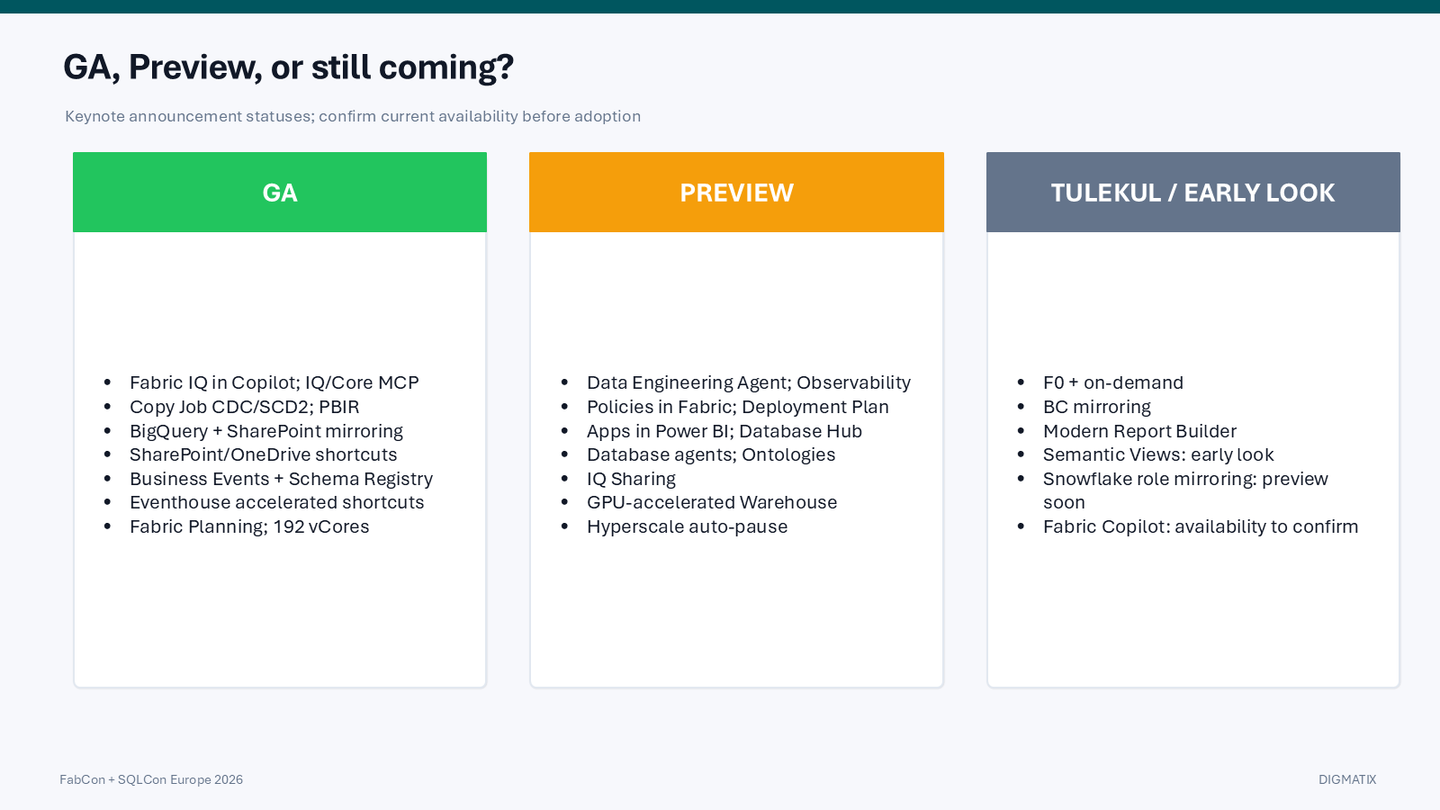
He did not retell the keynote in order. His map grouped the news by workload into six areas: pricing, AI and semantics, apps and BI, data, operations, and the platform. Every slide carries a status label: GA, preview, announced, or "tulekul", Estonian for "coming".
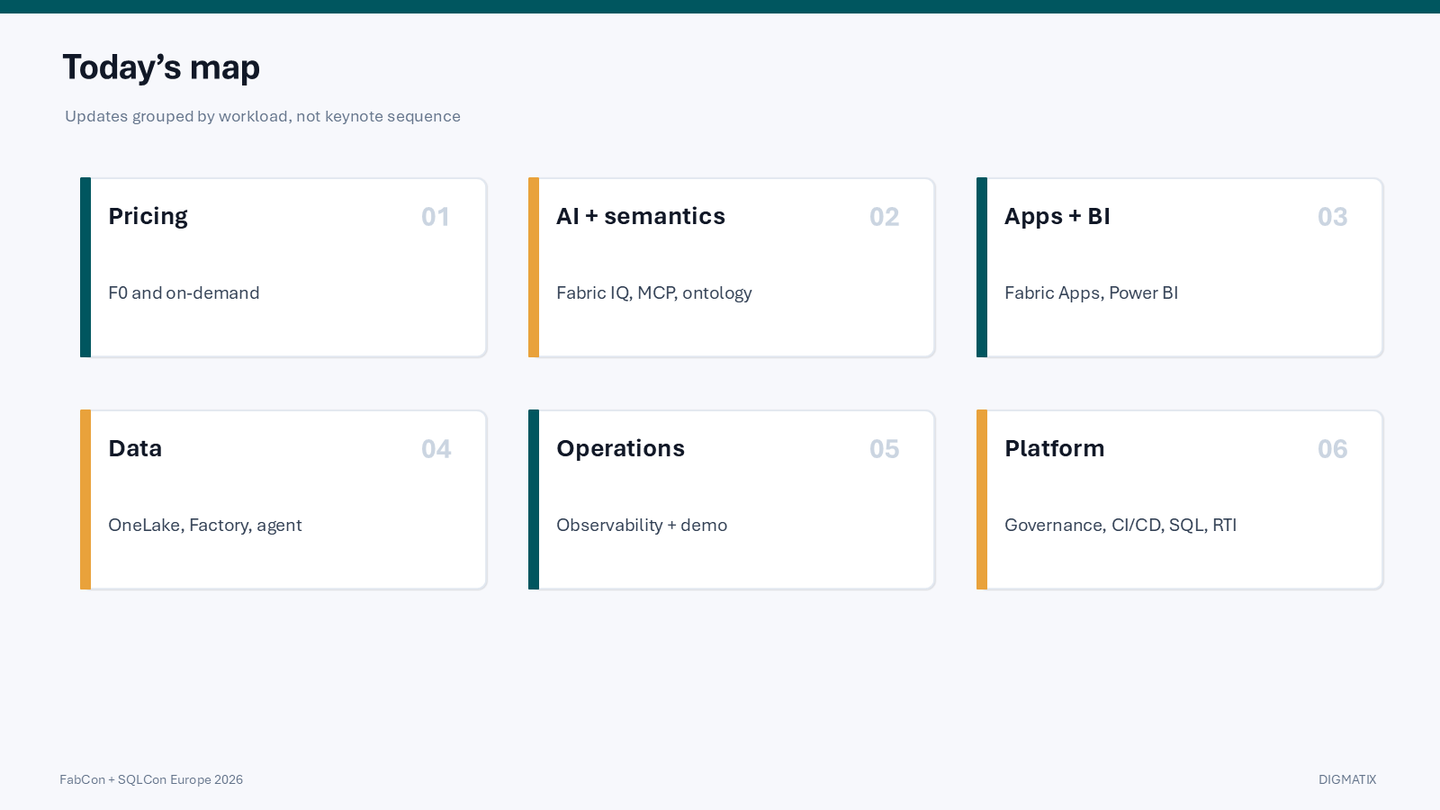
F0: Fabric without a capacity bought up front
On-demand billing expands to all Fabric workloads, with F0 as a "zero-provisioned" starting point. A preview was announced for the coming weeks, and the exact pricing was not public when Microsoft announced it. The slide puts the catch plainly: F0 does not mean free Fabric, and the pricing decides when the model makes sense.
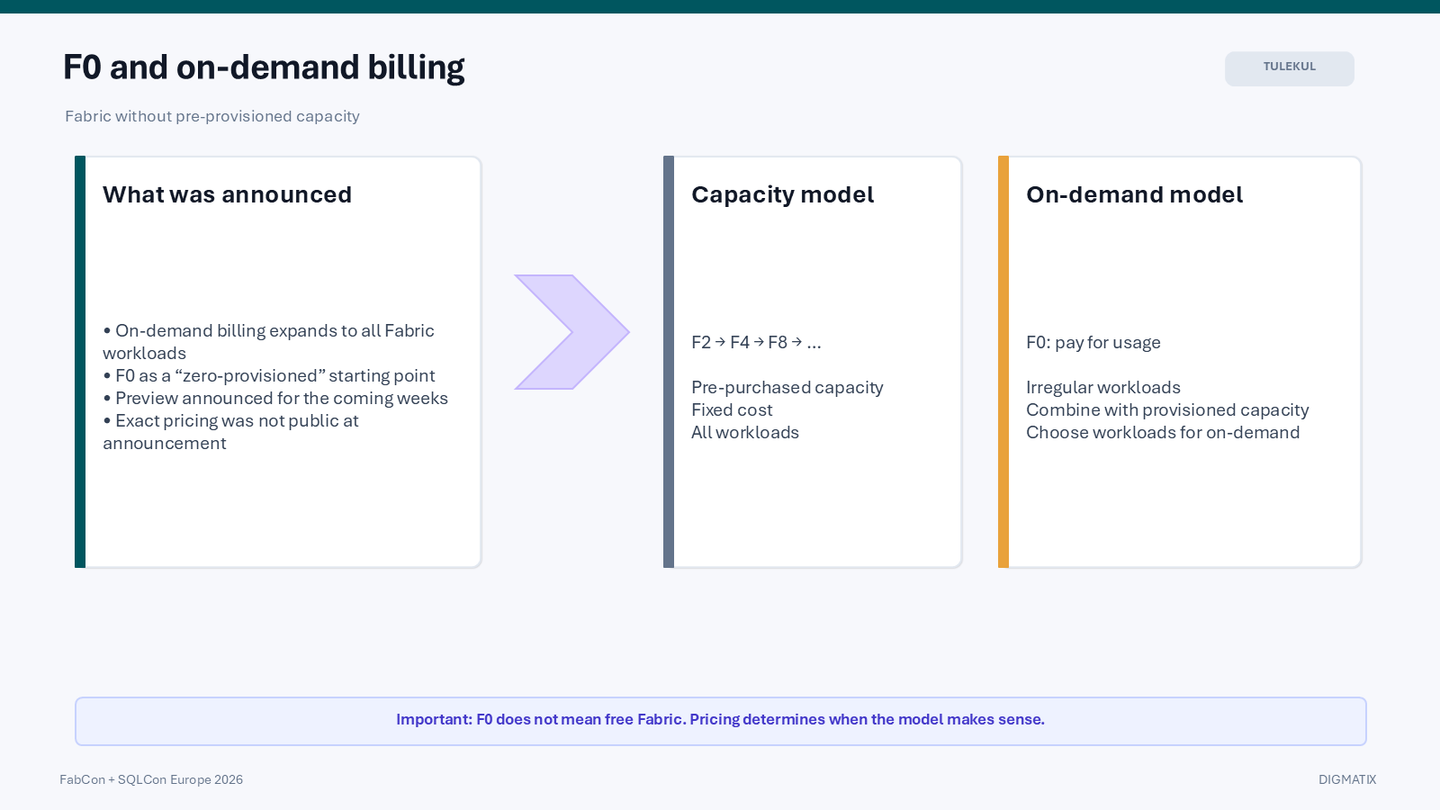
From report to app
Apps in Power BI is meant for Pro, Premium Per User and Fabric capacity customers, with Fabric Apps and Fabric Database at up to 1 GB per app. The Modern Report Builder describes a report in natural language in Power BI Desktop and publishes it as a Fabric app. Rayfin is the open-source SDK behind Fabric apps. Marek's question for the room: when is it a Power BI app, when a Fabric app, and when a Power Apps case?
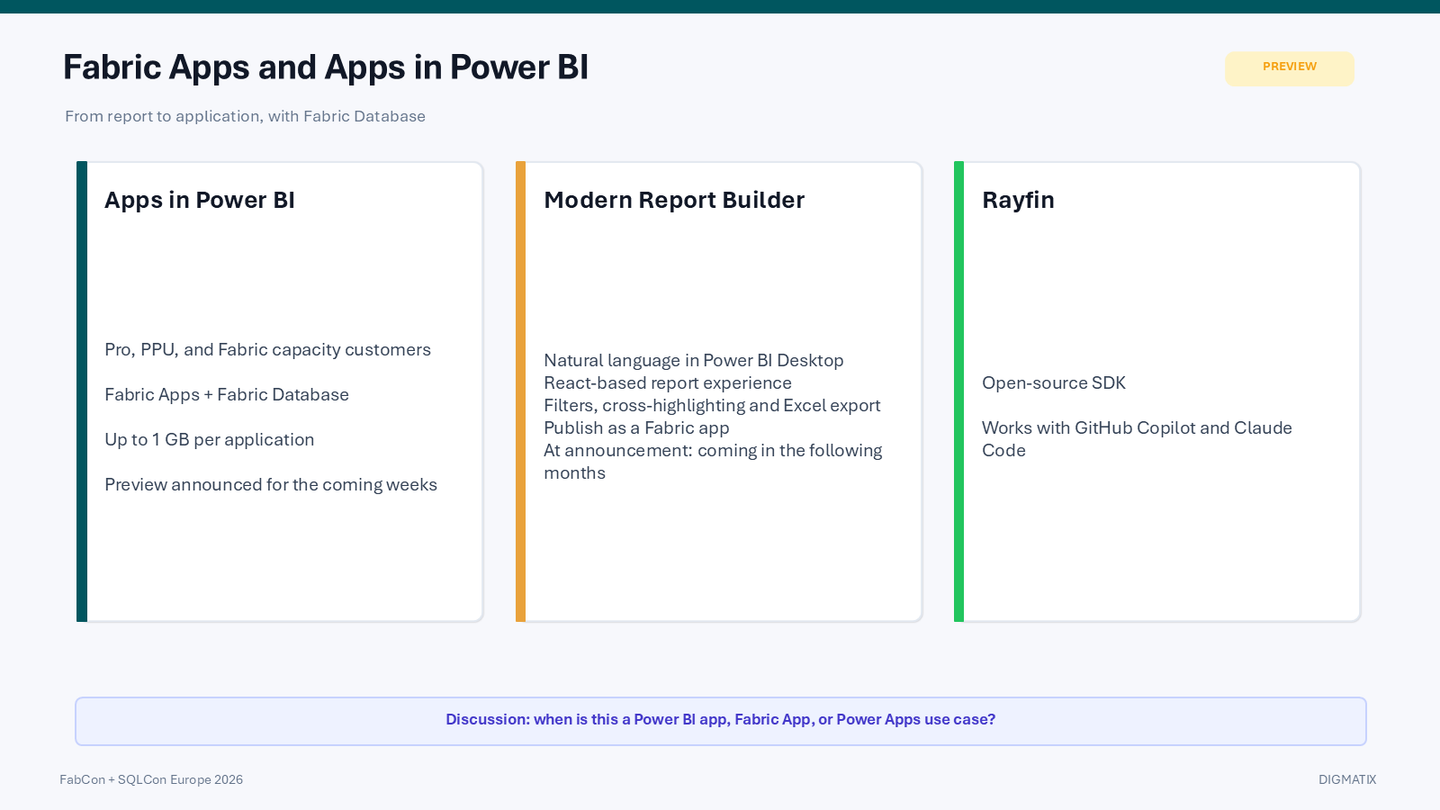
GA, preview or still coming?
His summary slide gives each item the status it had when the keynote announced it, and asks you to confirm current availability before you adopt anything. Our own status picture further down was checked against Microsoft Learn on 9 November, so a few rows differ. Apps in Power BI, for example, sits under preview on his slide because Microsoft announced the preview for the coming weeks, but it had not appeared by 9 November.
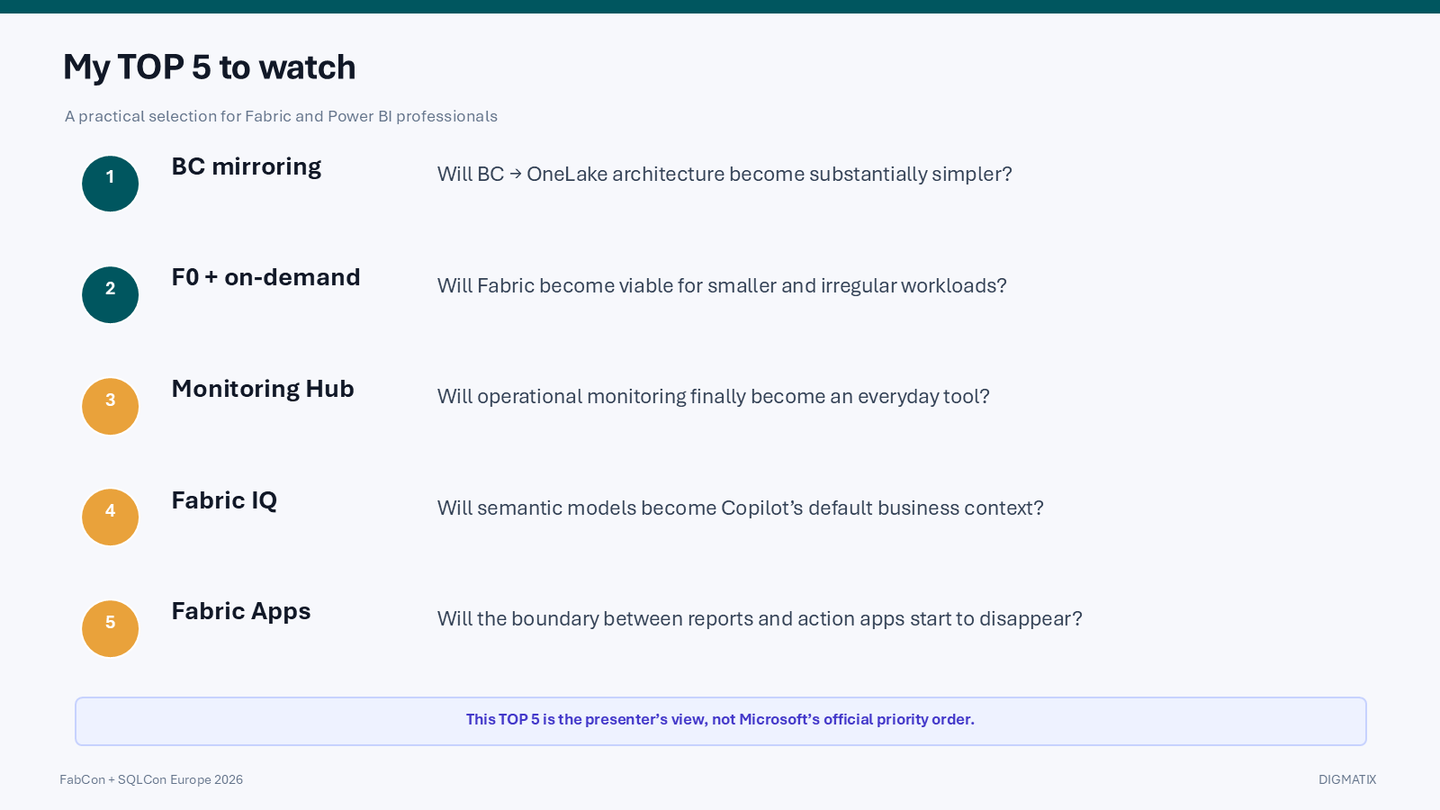
Marek's top 5 to watch
- Business Central mirroring: will the architecture from Business Central to OneLake become substantially simpler?
- F0 and on-demand billing: will Fabric become viable for smaller and irregular workloads?
- The Monitoring Hub: will operational monitoring finally become an everyday tool?
- Fabric IQ: will semantic models become Copilot's default business context?
- Fabric Apps: will the boundary between reports and action apps start to disappear?
The slide says it itself: this is the presenter's view, not Microsoft's official priority order.
The full deck also covers Fabric IQ in Copilot, the MCP servers and ontology, Fabric Planning, the Project Osmos data engineering agent, a unified Fabric Copilot, OneLake mirroring, IQ sharing, Data Factory, observability, governance and security, CI/CD, SQLCon's database news, the GPU-accelerated warehouse and Real-Time Intelligence. Download Marek Kõbu's slides (PDF, 23 slides, 1.5 MB).
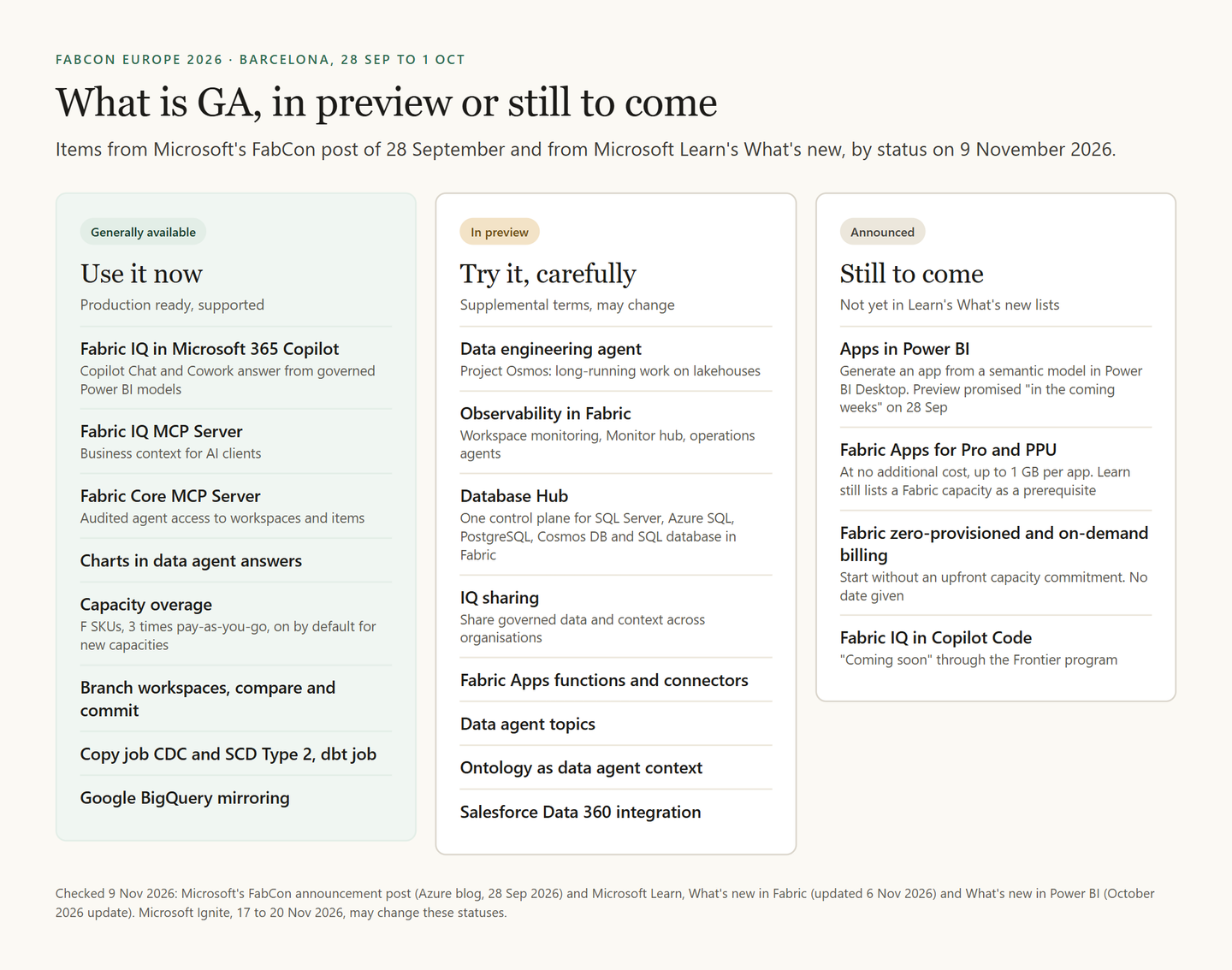
What did Microsoft announce at FabCon Europe 2026?
FabCon Europe 2026 ran from 28 September to 1 October 2026 at the CCIB in Barcelona, together with SQLCon Europe. Microsoft's main announcement post, by Arun Ulag, framed Fabric as the data foundation for Copilot and agents. Microsoft Learn's What's new in Fabric adds the items that reached general availability in September 2026, the month of the conference.
Generally available.
- Fabric IQ in Microsoft 365 Copilot: Copilot Chat and Cowork answer business questions from governed Power BI reports and semantic models. Microsoft says Copilot customers pay no additional AI token costs for it.
- Two MCP servers: the Fabric IQ MCP Server brings governed business context to AI clients, and the Fabric Core MCP Server gives AI agents audited access to workspaces, items, permissions and capacity information.
- Listed as GA in September 2026: charts in data agent answers, capacity overage, branch workspaces with compare and commit for Git, Copy job CDC and SCD Type 2, and dbt jobs in Data Factory.
- Google BigQuery mirroring, announced as generally available in the post.
In preview.
- The data engineering agent (Project Osmos) plans, runs and checks long-running data engineering work on the lakehouses it is authorised to use. Microsoft built it on technology from its acquisition of Osmos earlier in 2026.
- Observability in Fabric brings workspace monitoring, the Monitor hub and operations agents together.
- Database Hub is one control plane for SQL Server, Azure SQL, PostgreSQL, Azure Cosmos DB and SQL database in Fabric.
- IQ sharing shares governed data and business context with other teams, customers and partners.
- Also in preview: the two-way integration with Salesforce Data 360, Fabric Apps functions and connectors, data agent topics, and ontology as data agent context.
Announced, still to come.
- Apps in Power BI: in Power BI Desktop you start from a semantic model, describe the app you need, generate it, edit it and publish it to Fabric. On 28 September Microsoft promised the preview "in the coming weeks" for Pro, Premium Per User and Fabric capacity customers, with Fabric Apps and Fabric Database capabilities at no additional cost for Pro and Premium Per User, up to 1 GB per app. As of 9 November 2026, neither Learn's What's new in Fabric nor the October 2026 Power BI update lists it.
- Fabric zero-provisioned and on-demand billing: start with Fabric and OneLake without an upfront capacity commitment, and pay only for the compute you use. Microsoft's post gives no date and no prices.
- Fabric IQ in Copilot's new Code experience: "coming soon" through the Frontier program.
What should a team check now?
Capacity overage. A capacity is the fixed block of computing power you pay for in Fabric. When a capacity runs over its limit, Fabric throttles: it delays or rejects work. With capacity overage on, Fabric bills the excess instead, at three times the pay-as-you-go rate on a separate meter, up to a rolling 24-hour threshold that the capacity admin sets. It works for F SKUs only, and Learn says it is enabled by default when you create a capacity. Three things to know, from Microsoft Learn:
- The threshold is not a hard spending cap. Work that is already running continues, so charges can go past it.
- Keep the threshold below one third of the daily CU hours. That is the point where overage costs about as much as a bigger SKU: under 16 of an F2's 48 CU hours a day, for example.
- It does not make anything faster. It only prevents throttling. If you hit overage often, Learn says to scale up instead.
Check the overage setting and threshold on each capacity in the admin portal, and Microsoft's current price list for the pay-as-you-go rate in your region.
Your region. Microsoft Learn's region availability page (3 November 2026) lists Fabric apps as available in North Europe and West Europe, and not in Poland Central, Spain Central, UK South or Switzerland West. The same page lists Observability in Fabric as not available in North Europe. Check your capacity's region before you plan around either.
Your licence. As of 3 November 2026 a Fabric app still needs a workspace with Fabric capacity. Teams with only Power BI Pro or Premium Per User wait for Apps in Power BI.
What is a Fabric app?
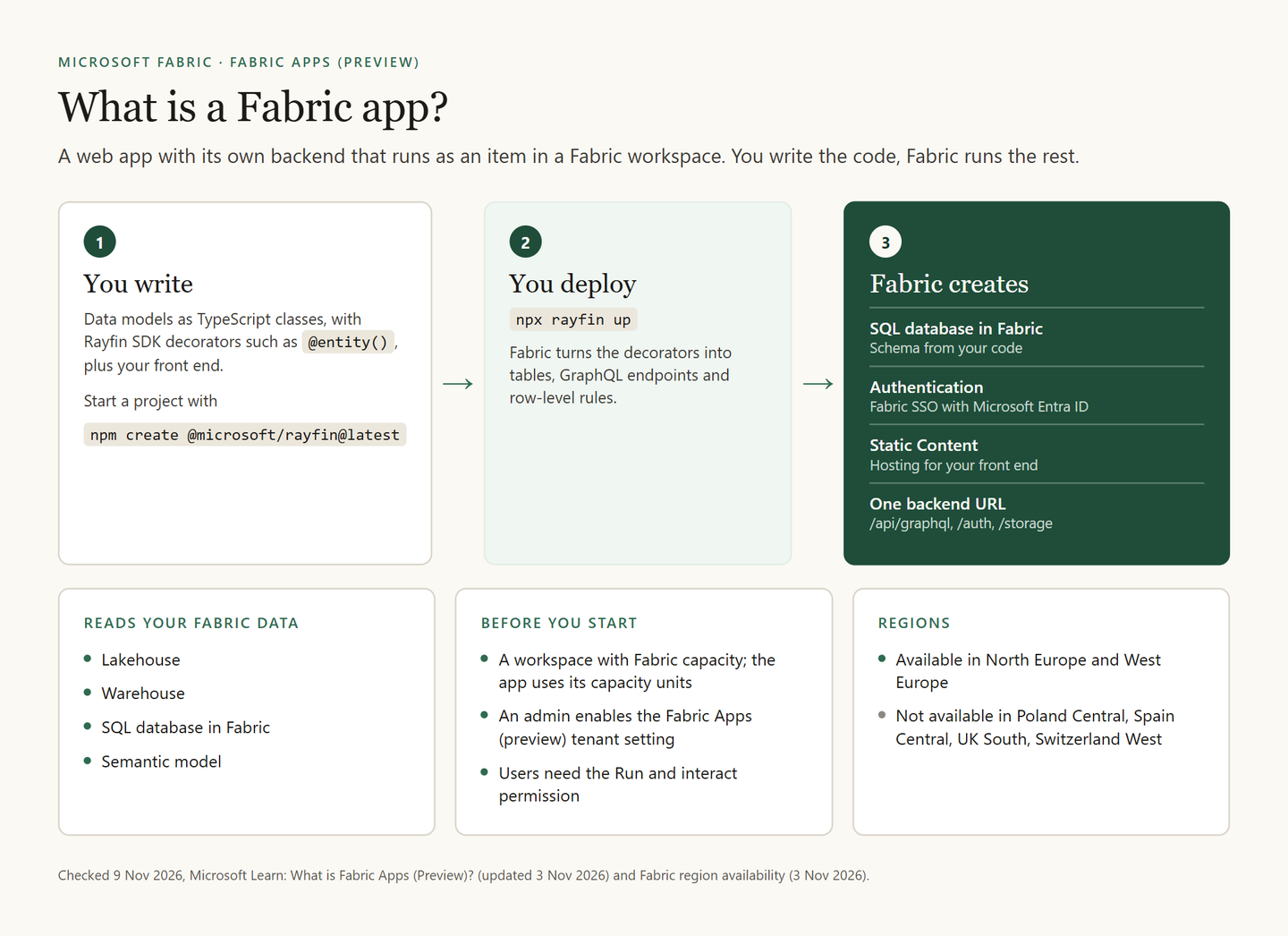
A Fabric app is a web application with its own backend that runs as an item in a Fabric workspace. You define the data model in TypeScript with the open-source Rayfin SDK, and Fabric generates the GraphQL API, handles sign-in through Microsoft Entra ID and hosts the front end. Microsoft launched Fabric Apps in June 2026, and they are still in preview.
An admin switches it on
A Fabric admin enables the Fabric Apps (preview) tenant setting, for everyone or for chosen security groups.
Pick a workspace with capacity
The app uses that capacity's computing power.
Scaffold and model
Create a project with
npm create @microsoft/rayfin@latest. Describe your data as TypeScript classes with decorators such as@entity(), and Fabric turns them into tables, GraphQL endpoints and row-level rules. You can run the whole stack locally with Docker first.Deploy
Run
npx rayfin up. Fabric creates three child items under the app: a SQL database in Fabric, Authentication and Static Content.Share
Colleagues need the Run and interact permission. Workspace members get it by default.
Four things Microsoft Learn says that are easy to miss:
- Sign-in is Fabric SSO only once deployed. Email and password work only during local development.
- The database is read-only in the portal. Schema changes come from your code through
npx rayfin up. Manual changes can break the app. - Workspace roles do not override item permissions. Share the app itself with Run and interact.
- One backend address. Each app gets one URL, with paths for the GraphQL data API, sign-in and file storage.
Microsoft suggests Fabric apps for quick prototypes, internal tools, data exploration front ends and AI agents that need to keep state. It does not suggest them for complex multi-step transactions or for sign-in providers other than Fabric SSO.
Is a Fabric app the same as a Power BI app?
No. Microsoft Learn keeps three kinds of app apart, and template apps are a fourth:
| App | What it is | Status |
|---|---|---|
| Workspace app | The classic Power BI app that packages reports | Still in use |
| Org app | A Fabric item, the newer evolution of workspace apps | Generally available |
| Fabric app | An application with its own backend | Preview |
Existing workspace apps are not renamed, upgraded or migrated automatically, according to Learn.
What comes next?
- Microsoft Ignite, 17 to 20 November 2026 in San Francisco. News there may change the statuses above.
- FabCon 2027, with SQLCon, 8 to 12 March 2027 at the Georgia World Congress Center in Atlanta.
- FabCon Europe 2027, 25 to 28 October 2027 at RAI Amsterdam, according to the organiser, ESPC.
- The group's next meetup: the date will appear on the events page.
Frequently asked questions
When and where was FabCon Europe 2026?
From 28 September to 1 October 2026 at the CCIB in Barcelona, together with SQLCon Europe. Microsoft counted nearly 5,000 attendees and more than 130 sessions, and called it its biggest European FabCon so far.
Where is FabCon Europe 2027?
At RAI Amsterdam, from 25 to 28 October 2027, according to the organiser, ESPC.
What is a Fabric app?
A web application with its own backend that runs inside a Fabric workspace. You write the data model in TypeScript, and Fabric creates the database, API, sign-in and hosting.
Is Fabric Apps still in preview?
Yes. Microsoft Learn marks Fabric Apps as a preview feature (page updated 3 November 2026). Microsoft launched it in June 2026.
Can I build a Fabric app with only Power BI Pro?
Not yet, according to Microsoft Learn on 3 November 2026: a Fabric app needs a workspace with Fabric capacity. Apps in Power BI, announced on 28 September, would change that for Pro and Premium Per User customers.
Are the slides or a recording available?
Marek Kõbu's slides are: five key slides are in this recap, and the full deck is a PDF, also linked from the event page. There is no recording on this site.
Are the meetups free?
Yes, as always. Each meetup has its own event page with registration.